Getting deposit-return ready: What retailers need to know when buying a reverse vending machine
If you’re a retailer in a region preparing to implement a deposit return scheme (DRS) for drink container reuse and recycling, now is the time to understand how your system will work, and how to choose the right reverse vending machine (RVM) for drink container returns.
A deposit return scheme is a proven way to reduce litter and encourage recycling. Consumers pay a small deposit on drink containers at purchase, which they get back when they return it for recycling. DRSs are typically introduced to help combat litter, increase recycling, reduce greenhouse gas emissions, and drive a circular economy. The European Union’s Packaging & Packaging Waste Regulation also adds a requirement that member states set up a deposit return system (DRS) by 2029 to achieve targets for separate collection of drink containers and recycled content in containers. Adding a financial value to the used container motivates people to recycle, and communicates the materials also have a value to society as a resource. Learn more about deposit return scheme best practice in TOMRA’s white paper.
Deposit return systems are usually brought in through legislation, and the way they run differs from country to country. One of the most common DRS models is "return-to-retail", where retailers selling eligible beverage containers are often legally responsible for taking them back. Nine out of 10 of the world's best-performing DRSs employ some form of return-to-retail collection, achieving an average return rate of 92%*.
Many retailers use reverse vending machines to automate the return process and make it more efficient. RVMs sort the recyclable materials and issue deposit refunds, often as a receipt that can be used as in-store credit, though they can also be received as a digital voucher or via a store loyalty program. Offering an easy and engaging container return experience can help to drive traffic to stores and build customer loyalty.
Retailers need to be ready for deposit return
TOMRA carried out a study examining the retailer buying process, speaking to decision-makers across Ireland, Spain, Portugal, Central Europe and the UK who are currently using, or evaluating, reverse vending solutions.
Andrew Boyle is Sales Manager for TOMRA Collection in Ireland, where DRS launched in February 2024. Ireland’s retailers are obliged to take back drink containers (whether through an RVM or manually), and those under 250m2 can apply for exemption.

The first key step for retailers is to learn about their responsibilities under a DRS and the set-up of the deposit system in their country, so that they are ready to discuss how drink containers can be collected most efficiently and effectively.
“Acting early ensures a store can meet its collection obligations in time for the DRS launch. In Ireland, the bigger supermarkets here all have reverse vending machines, and we are happy to see smaller retailers enjoying more and more the benefits of automation.”
In agreement was Dorin Mihai, Managing Director of TOMRA Collection in Romania, where DRS was launched in November 2023. Romania's retailers have the legal obligation to receive containers, regardless of store size, and they can also choose whether to collect drink containers through automation or manually.
“When DRS was set for Romania, it was new and unfamiliar for many retailers,” said Dorin Mihai.
We saw though some early adopters of reverse vending machines, who recognized that being among the first to offer reverse vending would make them stand out. They felt it could give them a competitive advantage, and showcase their store as pioneering, innovative, and responsive to their customers' needs.

Automated bottle and can collection for retailers
Some retailers choose to collect drink containers manually, though this can take space and time, and be subject to human error. Stores need to count containers, check if they are eligible, issue deposit refunds, and log what has been returned. Store staff must also sort the containers so the different materials (e.g. PET plastic, aluminum and/or glass) are separated ready for collection, and must use valuable retail floorspace on storing uncompacted containers.
In contrast, automating drinks container collection with an RVM can save precious time and free up staff resources. The machines check, sort and store the materials, issue refunds, generate reports and for deposits and handling fee clearing and log all the data electronically. They also compact (crush) containers, requiring less store space to be spent on container storage and less frequent emptying of storage bins since more containers can fit in – particularly vital for smaller stores with little backroom storage space.
Retailers of all sizes can find an RVM to suit their needs, from large supermarkets processing high volumes, to smaller convenience stores that need a compact machine to preserve valuable space on the sales floor.
Automated take-back removes the potential for human error so retailers can be sure that accurate deposits and handling fees are paid out. It also reduces potential for fraud, as RVMs reject ineligible containers, and ensure deposits can only be redeemed once (by crushing/shredding or securely storing containers).
By making the process quick, easy, convenient and accurate, automation gives retailers' customers a positive container return experience, which encourages them back into the store, builds customer loyalty, and gives stores an opportunity to differentiate.

What to know when buying a reverse vending machine – helping retailers choose
When Andrew Boyle began approaching retailers to discuss RVM options, he was mindful that he was asking them to make big decisions around technology that was completely new to them.
“Retailers should choose an RVM partner who will take the time to understand their space and needs, and advise on the size and specifications of a machine that’s right for them. It’s my job to identify opportunities for them and provide retailers with the best machine possible,” he explains.
“For example: small space? TOMRA B5 is a user-friendly, compact, entry-level machine. Is your site the only return point in a community, with high foot traffic? Maybe TOMRA T70 Dual is a better option. It’s also a freestanding and compact machine, and with a slightly bigger footprint offers more internal storage capacity and its two compactors can handle two separate two material types at the same time.”
TOMRA has a large portfolio of reverse vending products – from small entry-level machines for more price-conscious retailers, to more advanced modular solutions for high volumes. Some businesses might even need different RVM types for different locations. For example, TOMRA Collection supplied a hospitality business with a high-volume TOMRA T90 in the public area for customers and a TOMRA M1 (the smallest standalone machine in the market) in its canteen.
Retailers can also prepare for RVM discussions by examining their figures, to help them anticipate return on investment. This includes how many customers come through the door, and how many beverages are sold every year, which can be used to estimate the level of container returns per annum. Retailers can share these statistics with their reverse vending machine partner who will help them make an informed decision about the type of machine to match their needs.
To help retailers choose the right reverse vending solution, the process typically begins with a store visit where TOMRA’s team evaluates the store’s needs, layout and operational possibilities. This on site assessment ensures we understand factors such as available space, expected container volumes and the retailer’s preferred customer flow, to support efficient operations. Based on these insights, TOMRA creates a tailored technical plan, including detailed AutoCAD/3D drawings of the proposed reverse vending machine placement and the front-end or backroom layout. Once the planning stage is complete, TOMRA prepares a customized offer that outlines the recommended configuration and options best suited to the retailer’s requirements, optimized for both their space and their business needs.


A reverse vending partner you can trust
TOMRA has over 50 years' experience in deposit return systems, working in more than 40 deposit markets, in every part of the value chain – from reverse vending infrastructure and network operation, to material pick-up and data management.TOMRA was founded in 1972 on the innovation of the world’s first fully-automated reverse vending machine, and helping retailers solve the challenge of how to make beverage container returns convenient for both store staff and their customers. Today, TOMRA’s over 91,000 reverse vending machines, in over 60 markets, collect more than 53 billion drink containers for recycling each year.
With our 50-year track record, TOMRA is a company that retailers can rely upon to deliver a proven, high-quality product and provide the service stores need to keep their container returns operating smoothly and efficiently – both now and in the future.
TOMRA’s role in a deposit return scheme often grows as the market matures, as TOMRA concretely proves itself as a reliable reverse vending provider with high uptime and availability, and a service partner who is there for stores to ensure consistent service to their customers.
Cost and features in RVM selection
In some regions and for some products, RVMs are purchased outright by the customer with an additional service package, or offered on an all-inclusive rental basis. In specific markets, return locations get access to an RVM up front and pay a small amount for each container accepted (known as a "throughput lease"). Return locations are sometimes paid a “handling fee” by the deposit return system operator to cover operational costs and investment associated with container returns. Learn more about reverse vending machine pricing.
Reliability and machine longevity stand out as critical priorities when choosing an RVM, such as accommodating weather conditions and avoiding machine downtime. “TOMRA's RVMs have built a strong reputation for enduring performance, designed to handle high-volume returns, and to be perfectly adaptable for indoor and outdoor returns, while minimizing maintenance needs," said Dorin Mihai.
An array of APIs and digital tools easily integrate TOMRA’s machines into retailers’ digital ecosystems. Data collection, real-time status notifications, guidance, industry-leading security protocols, and the ability to set up digital payouts are all ways this technology enhances the container return experience. Retailers can even integrate RVMs with their own loyalty schemes, and allow customers to donate their deposit to a chosen charity, boosting customer engagement.


Where do you put a reverse vending machine?
Selecting the best location for an RVM is important when choosing the right reverse vending machine. There are a range of considerations:
- Inside or outside: While many retailers want their RVMs in-store, some retailers place it outside – under a covered shelter within their car parks or forecourts.
- Floorspace: The ideal machine size if influenced by a store’s footprint and desired storage capacity, and the store layout will determine where machines can be situated.
- Avoiding congestion: Retailers should consider “pinch points”, and choose a location that allows customers to move past the machine freely while others are returning containers.
- Accessibility: Consider ease of access for customers to reach the RVM.
- Power and data: Proximity to a power source and network connectivity is crucial.
RVM service and maintenance and support
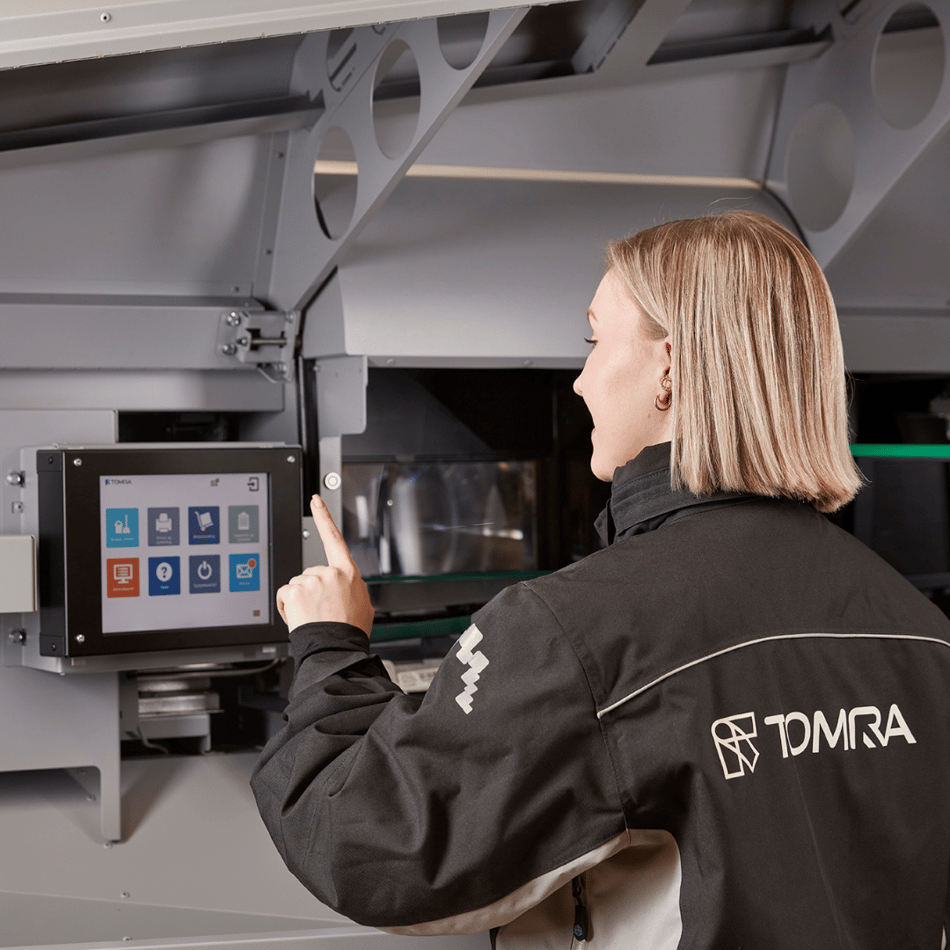
Retailers assessing RVM options should also consider the practicalities of day-to-day running and troubleshooting. It’s important to find out what’s required when it comes to maintenance and cleaning – and crucially, what type of support you will get if you have any issues.
When TOMRA installs an RVM, it works with store managers and staff to ensure these things all become a simple part of their everyday routine. Training is provided on use, cleaning, emptying and accessing TOMRA support.
TOMRA’s technicians can monitor RVMs 24/7 and if an issue does arise, in most cases it can be resolved remotely. If that’s not possible, TOMRA Collection has a network of approximately 1300 local field service technicians around the world (as at October 2025), with quick response times, keeping machine down-time to an absolute minimum.
TOMRA, and not third-party companies, always holds responsibility for after-sales care and maintenance. TOMRA stays by the retailer’s side throughout the entire journey, delivering consistent support and peace of mind.
Making the right RVM decision, first time
Andrew Boyle has encountered a number of retailers who have changed their minds after seeing competitors’ reverse vending machines in operation. He explained: “Some retailers who opted out of participating in the DRS came back to us just one year on, because they changed their minds. They experienced a downturn in trade, because consumers went to participating stores to return their containers, and didn’t want to miss out."
It’s so important to discuss your needs and numbers with your reverse vending partner, to get the right technology into the store from day one.
The best thing retailers can do when preparing for DRS legislation to launch is to get up to speed on their region’s DRS compliance rules and retailer requirements as quickly as possible.
A reverse vending partner like TOMRA, with vast experience in RVM technology for DRSs across the world, can help retailers navigate the legislation and find the solutions that will work best for them and their customers.
* The top 10 highest-performing container deposit systems in the world as of 2025 are, in order: Finland (99%), Germany (98%), Denmark (93%), Norway (92%), Lithuania (90%), Slovakia (90%), Estonia (89%), Iceland (89%), Sweden (88%), and Oregon, USA (87%). “Global Deposit Book 2024,” Reloop. 2025. And Global Deposit Dashboard latest rates.
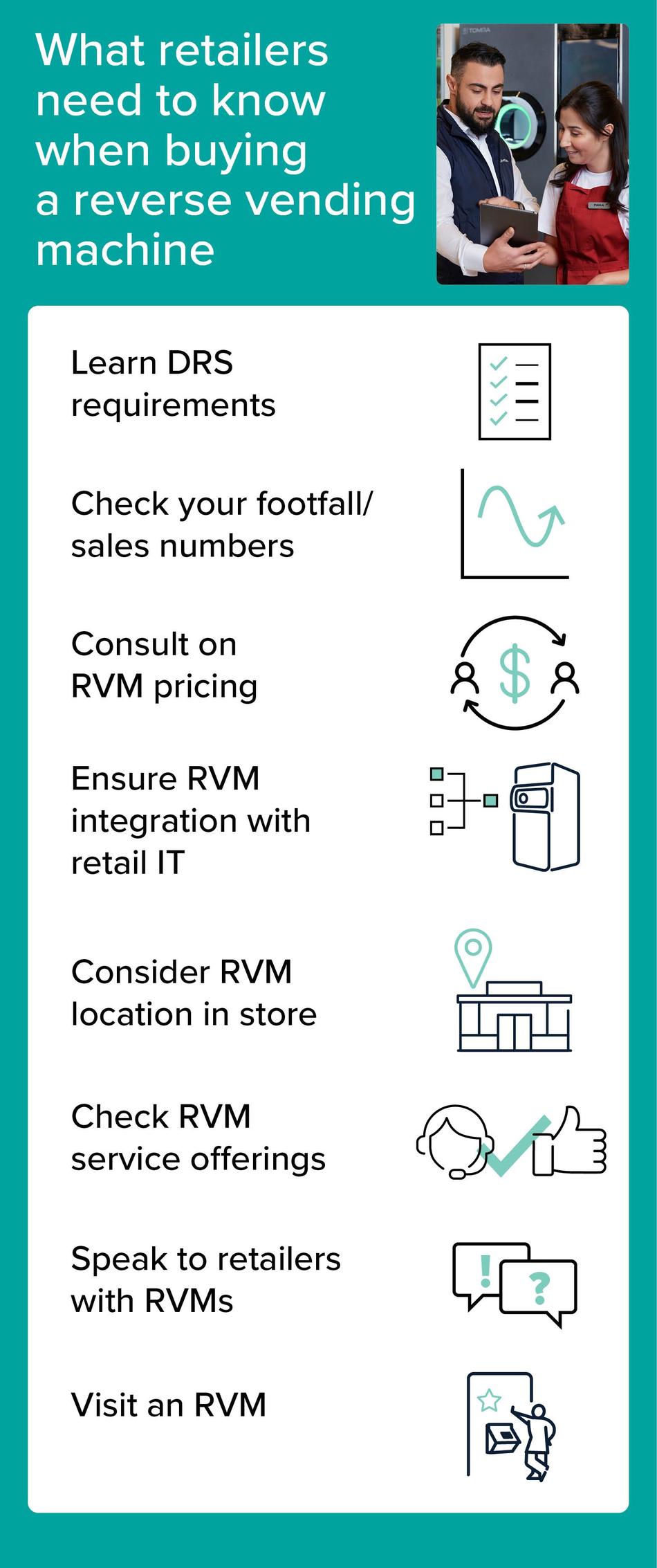
Quick guide: Retailer checklist for reverse vending machines
Key considerations to help retailers prepare for a deposit return system and reverse vending:
- Learn about DRS: Familiarize yourself with the requirements of your country’s DRS before it goes live.
- Think about numbers: Consider your footfall and drink container sales, as this will help determine what type of RVM(s) you will need to meet demand.
- Cost: Find out the costs and financing solutions for the reverse vending systems.
- IT: Ensure RVM integration with existing IT platforms and Point of Sales systems, for seamless and efficient processes.
- Location: Think about practicalities like accessibility, areas of high footfall, and proximity to data and power outlets.
- Service: Confirm what's required for RVM maintenance and cleaning of the RVM, and the support and service packages available in case of issues.
- Chat to other retailers: Speak to other retailers with RVMs in place, find out what lessons they’ve learned, and benefit from their insights.
- Visit an RVM: Don’t just look at a brochure; find out where there are RVMs in use (or on display at a trade show or showroom), for first-hand experience and insight.

Reverse Vending Machine Guide

Our Offering

Reverse Vending for Retailers
