
Customer Story
Tungsten West advances Hemerdon restart with TOMRA Mining sorting technology a key component of the redesigned plant
Tungsten West is deploying six TOMRA Mining XRT sorters equipped with OBTAIN™ Deep Learning technology at the Hemerdon tungsten mine in England, targeting ramp up to full scale production in the first quarter of 2027. With tungsten on the UK critical minerals list and Chinese export restrictions reshaping global supply, Hemerdon is positioned to become a strategically significant non-China source of tungsten for European industry.

TOMRA Mining is at the core of the redesigned processing plant at Tungsten West’s Hemerdon mine in Devon, England, as the project moves from re-starting operations in September 2026 through to full production in early 2027. Six TOMRA Mining XRT ore sorters, each equipped with OBTAIN™ Deep Learning technology, will form the backbone of a new sorting house at the mine’s front end. As tungsten prices rise and western industry seeks alternatives to Chinese supply, Hemerdon’s restart is one of the most significant developments in the critical minerals sector outside China.
A strategic moment for tungsten
Tungsten is one of the most industrially versatile metals on earth. Its unique combination of the highest melting point of all known elements (3,422°C), extreme density, and exceptional hardness in carbide form makes it indispensable across mining and construction tooling, transport, aerospace, defence, energy, and electronics. Demand is forecast to grow at a compound annual growth rate of between 2% and 5% through to 2033, requiring a minimum of 26,000 additional tonnes by that date.
Yet global supply remains heavily concentrated. China accounts for around 80% of tungsten concentrate production, and its domestic output has been declining as tighter environmental regulations reduce mining activity. Recent Chinese export restrictions have sharpened the focus of governments and industry on securing alternative sources.
In this context, Hemerdon’s restart carries significance well beyond a single mining operation. Tungsten is listed as a critical mineral by the UK government, and domestic tungsten production is a strategic priority for British supply-chain resilience. Based on its reserve base, Hemerdon could account for approximately 4.1% of global tungsten production – a meaningful contribution to non-China supply that will also support the broader European tungsten ecosystem, where a number of operations are working to reduce dependence on Chinese imports.
For tungsten producers navigating this market, the ability to ramp up quickly, process ore efficiently, and maximise recovery from complex ore bodies is a competitive necessity. For Tungsten West, the redesigned processing flowsheet and the integration of TOMRA Mining’s sorting technology are central to Hemerdon’s planned restart and to the company’s ambition to establish the mine as a world-scale, low-cost and long-life tungsten asset in the Western world. TOMRA Mining’s sensor-based sorting technology has a decisive role to play in making that possible.
The TOMRA sorters play a key role in our operating model. By reducing the amount of material that enters the full downstream processing circuit, they help lower our processing costs and environmental footprint, while allowing us to focus on the best recoverable tungsten feed.

Hemerdon: a tungsten resource of global significance
Located in Devon, England, Hemerdon holds one of the world’s largest tungsten resources and soon will be the largest tungsten mine in the Western world. The processing plant was originally built in 2014 and operated from 2015 to 2018, before ceasing production. Tungsten West acquired the mine in 2019 and has since undertaken a comprehensive programme of investment and redesign to bring it back into production on a more robust, environmentally compliant, and technically advanced basis.
Central to that redesign is a full rebuild of the plant’s front end: new primary crushing, screening, and a dedicated new sorting house, feeding into a system that also incorporates inline pressure jigs (IPJs) downstream. The combined front end is designed to increase feed grade and reduce the volume of material requiring full downstream processing. An independent review of the processing flowsheet by external industry experts, followed by an updated feasibility study signed off by independent specialists, validated the new approach and underpins the current restart programme.
Sensor-based sorting at the heart of the new front end
Following significant bulk test work conducted with TOMRA Mining to ensure that sorter performance parameters reflect future plant feed, Tungsten West has selected a six-sorter installation to process the 10-80mm fraction of material from the primary and secondary crushing circuit.
“The TOMRA sorters play a key role in our operating model, as they select the best material for our mineral processing facility. By reducing the amount of material that enters the full downstream processing circuit, they help lower our processing costs and environmental footprint, while allowing us to focus on the best recoverable tungsten feed. The material not selected for further processing also generates a high-value aggregate product for local construction activity,” says Jeffery Court, CEO of Tungsten West.
Material from the secondary crusher is fed to a stockpile, discharging via underground feeders to a wet screen that classifies it into three fractions: below 10mm, which passes directly to the pressure jigging and dense media separation circuits; 10-30mm, treated by three COM Tertiary XRT machines; and 30-80mm, treated by three COM XRT 2.0 units. All six sorters operate in parallel within the new sorting house.
The sorters are designed to direct approximately 30% of incoming material – the mineralised fraction – to the downstream concentrator for tungsten and tin recovery. The remaining approximately 70% is “rejected” as a premium aggregate by-product, available to the construction industry with close to zero incremental carbon footprint.

OBTAIN™: Deep Learning precision for tungsten ore
All six TOMRA sorters at Hemerdon will be equipped with OBTAIN, TOMRA Mining’s latest AI tool in sorting featuring proprietary Deep Learning technology, which introduces single-particle precision to high-throughput XRT ore sorting. Using a neural network to identify the properties of each individual particle accurately and independently of operating capacity, OBTAIN resolves a fundamental challenge in high-throughput sorting: the tendency for particles to be presented in clusters that the sensor reads as a single object, leading to imprecise ejection decisions. By breaking down those clusters algorithmically, the system enables accurate, particle-level decisions even at high feed rates.The practical result is a significant increase in effective sorter capacity: “With OBTAIN, we can feed each sorter with about 80% more material and have the same quality and the same recovery rates as before. In short, we can simply run double the capacity,” explains Jens-Michael Bergmann, Global Segment Manager Industrial Minerals at TOMRA Mining.
This capacity benefit is especially significant for tungsten ore, where mineralisation – primarily as wolframite (as is the case at Hemerdon) or scheelite – is typically present as discrete inclusions within host rock. Accurate particle-level detection is critical to both recovery and waste grade: OBTAIN’s precise, individual-particle sorting decisions, maintained even in dense, high-speed feed streams, minimise tungsten loss to the waste stream – a commercially significant outcome when prices place a premium on every recovered unit.
“We are delighted to have TOMRA as a long-term strategic partner for us at Hemerdon. The technology package we are installing represents a strong step-change for the project and will help ensure that we are a better and more resilient producer of tungsten over the long term,” says Jeffery Court, CEO of Tungsten West.
When you remove 70% of the rocks directly to the aggregate stream – without spending energy on crushing and grinding, milling and flotation and jigging – that is a huge amount of energy you do not spend.

Environmental design built into the plant
At the heart of the environmental case is the sorting process itself. By directing approximately 70% of the mined material to a premium aggregate stream without any downstream crushing, grinding, milling, or flotation, the system eliminates the energy consumption and associated emissions that processing that material would otherwise have generated. This is the basis for the close to zero-incremental-carbon-footprint aggregate by-product credentials, as Jens-Michael Bergmann describes: “When you remove 70% of the rocks directly to the aggregate stream – without spending energy on crushing and grinding, milling and flotation and jigging – that is a huge amount of energy you do not spend. This, alongside the increase in grade, is the main advantage of sorting: a significant reduction in carbon emissions.”A key supplier for the European tungsten market
Hemerdon’s restart comes at a moment of heightened strategic attention to tungsten supply across Europe. Alongside existing operations in Spain and Portugal, a new generation of tungsten projects is progressing across the continent, collectively working to reduce exposure to Chinese export policy. Hemerdon, with its scale and proximity to UK and European markets, is well placed to play a central role in that supply picture. TOMRA Mining's sensor-based sorting technology – and OBTAIN™ in particular – is central to that positioning, giving Tungsten West the processing efficiency, recovery performance, and operational confidence to bring a resource of this scale into production at the right moment.“With the addition of process improvements, environmental upgrades and new technology such as the TOMRA ore sorters, Tungsten West will be firmly positioned in the lowest quartile of the tungsten production cost curve globally. This supports Hemerdon’s longevity as a world-scale, low-cost and long-life tungsten asset located in the Western world,” says Jeffery Court, CEO of Tungsten West.
With all six TOMRA Mining sorters scheduled for installation through Q4 2026, Hemerdon is on course for full production from the end of Q1 2027, marking a significant step toward establishing a reliable, large-scale source of tungsten for European industry at a moment when the need for non-China supply has never been more pressing.
Products mentioned in this article
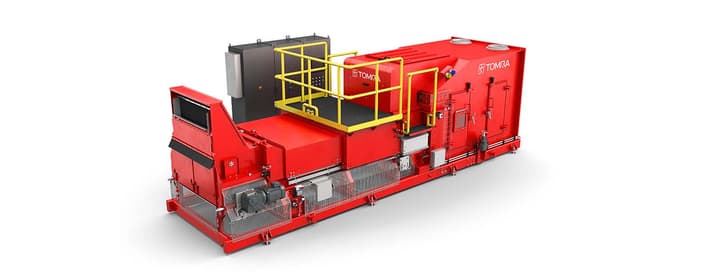
COM XRT 2.0
-
Designed for large particle sizes
-
Robust design for high tonnages
-
Proprietary DUOLINE® X-Ray camera
-
Multi-features image processing