30 years of AI sorting
Since 1996, AUTOSORT™ has been continuously optimized and strengthened. Today, it is widely recognized as the industry’s ultimate all‑rounder, trusted for its reliability, performance, and unmatched versatility.
But the AUTOSORT™ story is also the story of our industry: AI has always been at the core of TOMRA’s technology, shaping the evolution of intelligent sorting from the very beginning, and powering what’s next.

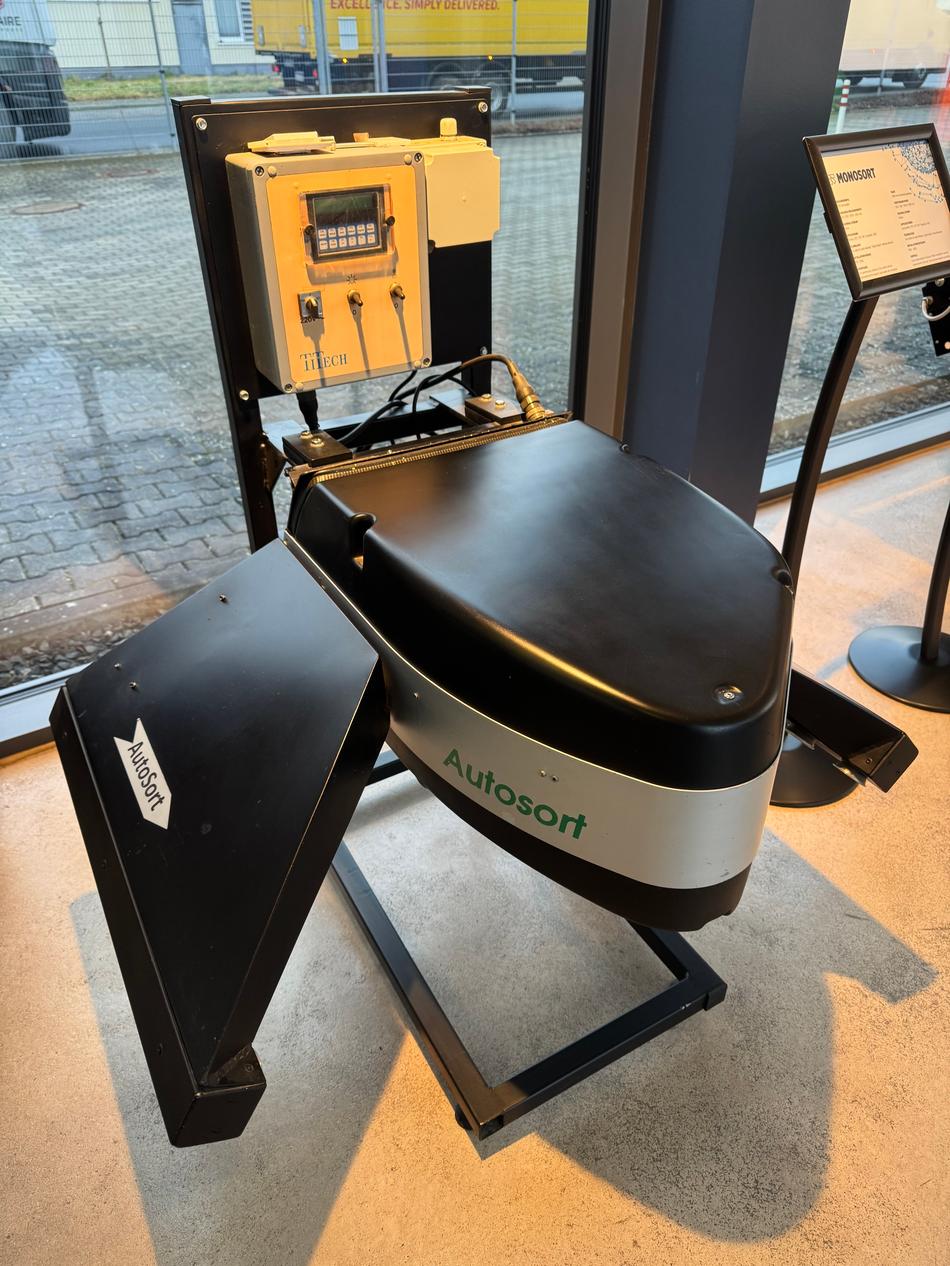
1996 – First optical AI sorter: AUTOSORT™
The debut of the first AUTOSORT™ model, the AUTOSORT 700, marked the beginning of automated, sensor-based sorting in recycling. Equipped with optimized optoelectronics, it employed early AI principles for basic decision-making regarding which materials to eject and reject. This represented a pivotal first step toward the AI supported material recognition we see today.
Due to the limited optical system and computing power of the era, the first-edition AUTOSORT™ could perform only one dedicated sorting task at a time using fixed rules. Its earliest applications included sorting beverage cartons and plastic bottles; at the time, new applications would have required a complete hardware modification.
2002 — Machine learning unlocks system flexibility
The growth of hyperspectral imaging and more flexible software configurations makes optical sorting significantly more powerful. By combining image analysis with spectroscopy, AUTOSORT™ becomes fully adaptable. For the first time, recyclers gain software-based control that allows the system to adjust to new and varied material streams without any hardware modification. This milestone transforms AUTOSORT™ into an adaptable, multifunctional sorter.
With this new flexibility, AUTOSORT™ can now efficiently process a broader range of materials – including plastics, paper and organic waste – and material separation becomes even more accurate.
2012 – FLYING BEAM™ enables a new level of optical precision

With the addition of an electromagnetic sensor, AUTOSORT™ expands beyond its standard NIR and VIS capabilities to reliably detect metals, transforming the platform into a true multi-sensor system.
Enhanced AI classification now interprets the combined data signals more intelligently, while advanced algorithms refine the underlying sorting logic. This results in superior recognition of complex material compounds, more consistent material separation, higher product purity, and improved yield for customers. Advancing computing power also makes it possible to increase optical resolution, allowing accurate sorting of increasingly smaller grain sizes.
At the same time, TOMRA’s patented FLYING BEAM™ technology marks a major milestone, introducing homogeneous, energy-efficient illumination that significantly sharpens NIR material detection and strengthens long-term system stability.
2019 – First deep learning solution: GAINnext™
TOMRA introduces GAINnext™, a groundbreaking addon for AUTOSORT™. While other sensors such as NIR or VIS sort by material type or color, this deep learning innovation uses RGB cameras to see what the human eye can see. TOMRA’s AI experts train the network with thousands to millions of images until it learns to distinguish visual characteristics such as specific bottle caps or packaging shapes. As a result, it tackles sorting tasks that previously required manual intervention.
The 2019 edition of GAINnext™ is trained to remove PE silicone cartridges from PE streams – an achievement that was impossible with earlier technology. This marks the first major deployment of deep learning in industrial sorting across the recycling industry.
2020 – Greater intelligence, more compact design
The 2020 AUTOSORT™ offers stronger performance in an ultracompact and highly modular design. It provides the broadest range of sensor and configuration options – allowing customers to tailor the system precisely to their application.
Enhanced AI driven detection enables the system to reliably distinguish materials using detailed shape and height information. It can accurately detect black plastics, rubber, and other optically challenging material.
With superior sorting sharpness, faster data processing, and more intelligent signal handling, AUTOSORT™ delivers exceptionally high accuracy and throughput – all within a single, easy-to-install housing that makes it a trusted solution for customers worldwide.
2024 – The deep learning ecosystem keeps evolving
Since its launch in 2019, the industry has seen a rapid expansion of deep learning applications. The GAINnext™ ecosystem has grown dramatically across wood, paper and packaging applications, solving some of the world’s most complex sorting tasks at high throughput and quality – well beyond what manual sorting can achieve. Examples include the challenging recovery of MDF, the detection of opaque bottles in PET streams and the identification of pizza boxes and egg cartons in paper streams.
A major breakthrough was reached in 2024, when the award-winning GAINnext™ enabled, for the first time ever, the separation of food-grade from non-food grade plastics – one of the recycling industry’s greatest challenges to date. This achievement demonstrates how deep learning is evolving into a true catalyst for material circularity, and its journey is only beginning.
Today – The connected core of modern plants

Today’s AUTOSORT™ systems combine AI, multi-sensor technology, and advanced image processing to sort an exceptionally wide range of materials with outstanding precision. Optional add-ons such as GAINnext™ for deep learning recognition, TOMRA Insight for cloud-powered data intelligence and TOMRA Local Control for smart sorter coordination further enhance optical performance, material identification and system-wide optimization. Together, they enable real-time monitoring, data-driven process improvements, and seamless integration into plant operations.
Connected to both internal systems and external devices such as PolyPerception’s waste analyzer and cloud-based performance dashboard, AUTOSORT™ has become the intelligent core in facilities worldwide, empowering operators to sustain optimal plant performance in terms of quality, throughput and uptime.
Since the early 2000s, Dirk Balthasar, VP Sensors & Systems at TOMRA Recycling, and our in-house AI experts have shaped AUTOSORT’s evolution step by step.
“AUTOSORT™ reflects how far recycling technology has come – and how deeply AI is rooted in TOMRA’s DNA. We’ve always used the best AI possible for each era, and we will continue pushing those boundaries in the future”.
Thirty years of innovation have shown that our AUTOSORT™ is far more than an optical sorting system – it’s a driving force in the recycling industry. And its evolution is far from over. As AI accelerates, new materials emerge, and customer demands grow, AUTOSORT™ is continuously preparing for the next leap forward. Its multifunctional design and unmatched application range have made it a trusted solution in about 80 countries.
Looking ahead, AUTOSORT™ will continue to raise the standard for intelligent, connected sorting and enable the transition to a circular economy.
