
EU Packaging and Packaging Waste Regulation (PPWR) begins applying across Europe
The Packaging and Packaging Waste Regulation (PPWR) begins applying across the European Union today. The same packaging rules will now apply in every Member State. This is one of the most significant changes to European packaging policy in decades.
The rules cover waste prevention and reduction, recyclability, reusable packaging and recycled content. Many requirements will be phased in over the coming years. Businesses and Member States now need to prepare for the deadlines ahead.
PPWR starts today. What happens next?
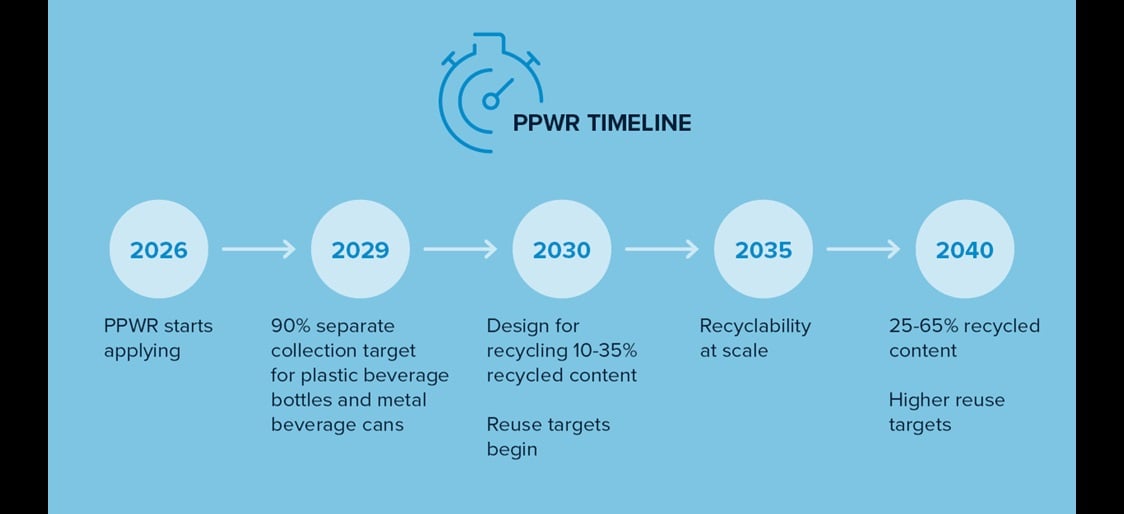
The main requirements arrive in stages. The first major deadlines fall in 2030, followed by further requirements in 2035 and 2040.
Among the milestones:
- By 2029: 90% separate collection for plastic beverage bottles and metal beverage cans.
- By 2030: packaging must meet design for recycling requirements.
- By 2030: plastic packaging must begin meeting recycled content targets ranging from 10% to 35%, depending on packaging type.
- By 2030: the first reuse targets for reusable packaging begin applying in selected sectors.
- By 2035: packaging must demonstrate recyclability at scale.
- By 2040: recycled content targets for plastic packaging increase to between 25% and 65%, depending on packaging type, alongside higher reuse targets.
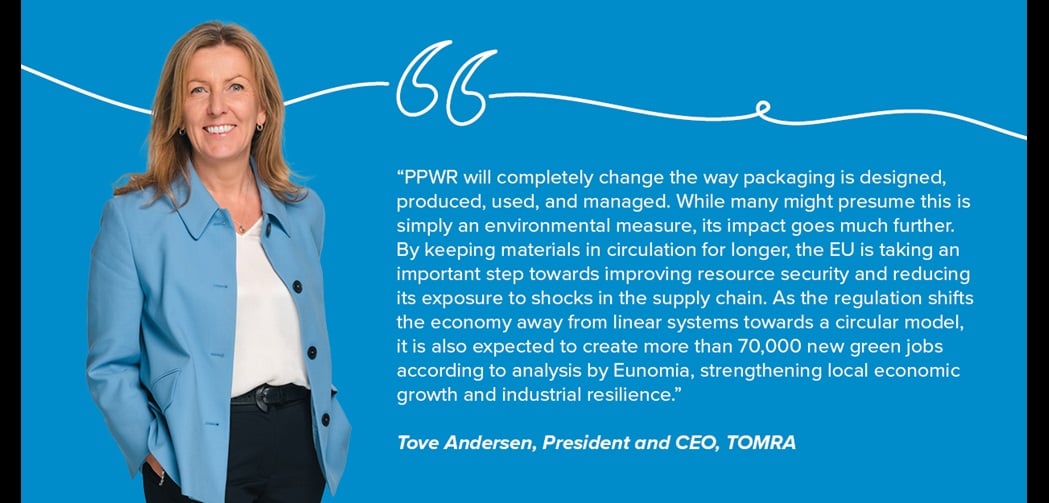
The changes will affect packaging design, how much recycled material packaging contains, where reusable packaging is introduced and what happens to materials after use.
The infrastructure behind the targets
Bottles still need to be collected. Packaging still needs to be sorted, graded and recycled. Reuse only works when returning packaging is straightforward for businesses and consumers. Europe will need enough collection, sorting, grading, recycling and reuse capacity to handle these materials. Much of that capacity still requires investment and collaboration across the entire value chain.
That work includes:
- Collection systems, from reverse vending machines to community collection points, that recover more valuable packaging before it is lost.
- Sorting and grading systems that separate materials into the quality streams needed for high-value recycling.
- Recycling infrastructure capable of turning used materials into new products through closed-loop recycling.
- Reuse systems that are practical for businesses and convenient for consumers.
Without these systems, the targets remain numbers in a regulation.
How the PPWR fits with existing EU rules
The PPWR joins other EU rules already changing how packaging is collected and recycled.
The Single-Use Plastics Directive (SUPD) already sets collection and recycled-content targets for beverage containers. Under the SUPD, EU Member States are required to separately collect 77% of single-use plastic beverage bottles by 2025 and 90% by 2029. In many markets, deposit return systems (DRSs) are helping to achieve high collection rates for beverage containers, and in fact the PPWR also adds a requirement that Member States set up a DRS by 2029 for at least plastic beverage bottles and cans to achieve those collection targets.
However, Member States may be exempted from setting up a DRS if they can achieve an 80% separate collection rate by 2026, and if they by 2028 submit a plan showing concrete actions and a timeline for how they will reach 90% by 2029. The SUPD and PPWR create a stronger foundation for keeping valuable materials in circulation, improving resource efficiency and reducing reliance on virgin resources.
As these policies increasingly align around common circular economy and climate neutrality objectives, the need for high-performing infrastructure becomes even more important.
Why action is needed now
Many PPWR requirements are still several years away. However, the infrastructure needed to meet them takes years to plan, permit and build. Preparation cannot wait for compliance deadlines to come.
Many businesses are already redesigning packaging, reviewing material choices and planning for new collection, extended producer responsibility and reporting requirements. For many, this is becoming part of a broader sustainability strategy: starting early brings a first-mover advantage, while protecting brand reputation and consumer trust along the way.
From policy to progress
The PPWR sets the requirements. Collection systems, sorting facilities, recyclers and reuse operators will determine how successfully those requirements are met. Good policy sets the direction. Building the systems is how policy becomes progress. Learn more about the PPWR and what it means for the future of packaging circularity: TOMRA PPWR resource page
Related articles

Circular technology trends in 2026: turning preparation to action

TOMRA leads global effort in circular economy: Takes on the role as Business Champion of the Global Circularity Protocol
