
insights from tomra reuse
Going circular with reusable packaging
The transition to a circular economy is reshaping how products are packaged, delivered, and consumed. Reusable packaging stands at the forefront of this movement, offering innovative models that reduce waste and environmental impact.
Page contents
- Why reusable packaging
- How reuse contributes to a circular economy
- The four main reuse business models
- Return on the go model
- The logistics of reuse packaging
- Design and material considerations
- The business case for reuse
- Reuse systems currently in use
- Consumer adoption
- Environmental impact of reusable packaging
- Regulations supporting reuse
Why reusable packaging?
You may ask, why should anyone bother to change to reusable packaging – isn't it cheaper and more convenient to use disposable packaging? Today, disposable packaging is indeed cheaper and more convenient for product suppliers and consumers to use than reusable packaging. Over a period of many decades, the value chain for producing, distributing and using disposable packaging has been continually honed, with the sole purpose of providing an inexpensive way to provide product packaging that can be used once and then thrown away. The problem is that this cost model does not include the associated external costs related to its use: the energy and resources used to create this packaging, and its significant waste management and environmental impact.
Where the traditional linear economic model follows take–make–waste, the circular economy aims to design out waste, keep materials in use, and regenerate natural systems. Reuse directly supports the second of these principles.
How reuse contributes to a circular economy
- Extends product life: By using the same item multiple times (e.g., refillable packaging, reusable transport totes, shared assets), fewer new products need to be manufactured.
- Reduces resource extraction and emissions: Reuse lowers the demand for raw materials and energy-intensive production, often resulting in significant carbon savings compared to single-use systems.
- Minimizes waste and pollution: When products remain in the loop longer, less waste is generated, reducing pressure on waste management systems and the environment.
- Enables system efficiency: Reuse models—such as take‑back programs, refill systems, rental services, or reverse logistics loops—create more efficient, closed-loop flows that support long-term sustainability.
- Creates new value streams: Service models around cleaning, collection, refurbishment, and redistribution open opportunities for innovation and recurring revenue.
In short, reuse is one of the most effective and scalable ways to shift from a disposable economy to a regenerative one, keeping materials circulating and reducing environmental impact.
The four main business models for reuse
As a consumer, you may be familiar with circular packaging solutions provided as part of one of these four main business models: Refill at home, Refill on the go, Return from home, or Return on the go.
This article focuses on the "Return on the go" model—a system where users receive products in reusable packaging and return the packaging at designated collection locations, where it is then picked up, cleaned, and then redistributed for further use. This approach is gaining momentum as organizations and consumers seek to adopt sustainable packaging alternatives.

Return on the go
The "Return on the go" reuse model enables consumers to return packaging at drop-off points, such as automated deposit return machines or simple collection bins. After collection, the packaging is cleaned and redistributed, closing the loop and minimizing waste. This returnable packaging system requires collaboration between businesses, regulators, and consumers to function effectively.
How it works:
- Consumers purchase products in returnable packaging.
- After use, packaging is returned to a designated location.
- Packaging is collected, cleaned, and prepared for reuse.
- The cycle repeats, reducing the need for single-use materials.
As the effectiveness of a reuse system depends on its ability to achieve high return rates and maximize the number of rotations of the packaging, reusable packaging will often include a financial incentive to return the packaging. Typically, the financial incentive takes the form of a deposit fee that is added to the packaging when a beverage or food serving is purchased, which is then refunded to the consumer when the packaging is returned. In some systems, the refunds are made with a cash disbursement, in others it may be a refund token that can be applied toward a new purchase of a new product delivered in reusable packaging. Some systems manage the deposit refund process completely digitally.

The logistics of reusable on-the-go packaging systems
A successful reuse system relies on seamless logistics across several stages:
- Delivery: Packaging is distributed to retailers.
- Use: Consumers utilize the packaging for its intended purpose.
- Collection: Used packaging is returned to drop-off points, collected and taken to a cleaning facility.
- Cleaning: Packaging is sanitized to meet health and safety standards.
- Redistribution: Clean packaging is returned to circulation to be used again.
Challenges include optimizing transportation routes, managing inventory, and ensuring timely cleaning and delivery of the reusable packaging. Solutions such as centralized cleaning hubs and digital tracking help streamline these processes.

Design and material considerations for reusable packaging
Effective reusable packaging must balance durability, safety, and user experience. Key considerations include:
- Material selection: Packaging should withstand multiple cycles of use and cleaning without degrading.
- Design for reuse: Features such as easy-to-clean surfaces, stackability, and ergonomic shapes enhance usability.
- Recyclability and use of recycled content: In Europe, the PPWR legislation will require that reusable packaging must not only contain recycled material but also be designed to be recycled at the end of its life (after it can no longer be reused).
- Branding and aesthetics: Packaging should reflect brand identity while remaining functional.
Other important design considerations for reusable cups, trays and bowls include transport and storage mechanisms, ancillary items such as lids, and how these materials can be efficiently cleaned, quality-assured and redistributed for use again.

The business case for reuse: Costs and ROI
While the upfront capital expenditure required to implement a reuse system for on-the-go packaging will vary depending on the size of the area where it is to be applied, there are a set of cost components that all such systems need to provide to function effectively: collection points for returning the reusable packaging, a system for picking up, cleaning and assuring the quality of the packaging before it is redistributed to the points of sale, and an IT platform to manage the whole system. The extent to which this system infrastructure can be shared and the costs distributed among various stakeholders and participants is a key factor for achieving a good business case.
Despite the upfront investment required, a transition to reusable packaging offers a number of long-term financial benefits:
- Cost savings: Reduced expenditure on single-use materials and waste management.
- Return on investment (ROI): Reusable packaging can be used multiple times, spreading costs over many cycles.
- Brand differentiation: Companies adopting reuse models can position themselves as sustainability leaders, attracting eco-conscious consumers.

Examples of reuse systems currently in use
Several organizations have successfully implemented "Return on the go" reuse systems:
- Retail chains: Offering reusable containers for groceries, with return stations at store entrances.
- Food delivery services: Using reusable packaging for takeout, collected via drop-off points or scheduled pickups.
- Beverage companies: Deploying deposit return machines for bottles and cups.
Case studies demonstrate that clear communication, convenient return options, and incentives are critical for driving participation and ensuring system effectiveness.
One of the most extensive systems for reusable on-the-go packaging yet implemented can be found in Aarhus, Denmark.
This city-wide system, known as REUSEABLE, includes some 53 participating retailers, an infrastructure of at least 25 automated reusable packaging return machines in the central part of the city which are open 24/7, and a standardized packaging pool consisting of seven different types of reusable cups for hot and cold drinks, food bowls, and lids. The system also has a specially designed facility for cleaning and sanitizing the system’s reusable packaging.
Another fast-emerging area of application for reusable on-the-go packaging is at arenas, festivals and amusement parks, as well as other venues and events with a high level of food and beverage consumption.
As closed-loop systems within private venues, such applications are easier to implement than systems in public spaces, yet still require an appropriate collection and cleaning infrastructure for the reusable packaging utilized. But with a well-planned implementation, using a reusable packaging system can offer venues attractive business benefits while contributing to sustainability commitments and the ability to conform with increasingly stringent packaging requirements.


Consumer adoption of reuse systems
Consumer engagement is essential for the success of reusable packaging initiatives. Factors influencing adoption include:
- Convenience: Easy access to return points and simple processes encourage participation.
- Incentives: Deposit refunds, loyalty programs, and discounts motivate consumers to return packaging.
- Awareness: Education campaigns highlight the environmental and economic benefits of reuse.
A survey conducted in Aarhus, Denmark in December 2024 to assess consumer satisfaction with the reuse system implemented that year in the city, showed that 84% of users who had tried the system were either satisfied or very satisfied with the experience.
The survey also showed that residents who use the reuse system more than occasionally tend to be more satisfied compared to citizens who have only used the system once or a few times. The tendency for satisfaction to increase the more frequently the system is used suggests that the added effort of returning the packaging to a collection point (compared to disposable packaging) is not in itself a hindrance to successful adoption of the system.

Environmental impact of reusable packaging
Reusable packaging offers significant environmental advantages over single-use alternatives:
- Waste reduction: Fewer materials end up in landfills or incinerators.
- Resource conservation: Lower demand for raw materials and energy.
- Carbon footprint: Reduced emissions from manufacturing and disposal processes.
Life cycle assessments consistently show that, when properly managed, reusable packaging systems deliver measurable sustainability benefits, supporting broader circular economy goals.
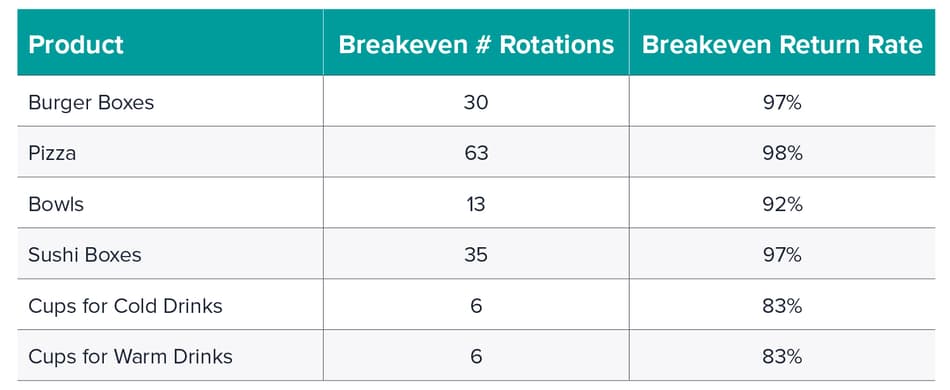
In a study conducted by Eunomia in 2023, it showed that reusable cups for warm and cold drinks could achieve lower greenhouse gas emissions compared to single-use paper cups, if the reuse system achieved a return rate of at least 83% and with at least six cup rotations within the system.
Regulations and structural mechanisms supporting reuse
The success of reusable packaging systems depends on supportive regulations and robust infrastructure. Without setting specific regulatory mandates that either disincentivize disposable packaging or incentivize reusable packaging alternatives, achieving a financially viable way to implement a return-on-the-go system is difficult.
Landmark legislation: The EU’s PPWR
The EU is leading the way at the multinational level with its Packaging and Packaging Waste Regulation (PPWR). The PPWR is a comprehensive legal framework aimed at reducing environmental impact, promoting a circular economy, and harmonizing rules across the EU. It mandates that all packaging is recyclable by 2030, sets strict waste reduction targets (15% per capita by 2040), restricts harmful substances like PFAS, and enforces minimum recycled content in plastic packaging. It also requires that restaurants and cafes must offer options for consumers to use their own containers by 2027 and provide reusable packaging for takeaway by 2028.
Key PPWR requirements for reusable takeaway packaging (effective Aug 12, 2026):
- Targets: 10% of ready-prepared takeaway packaging must be reusable by 2030.
- System requirement: Operators must participate in an established, functional reuse system, ensuring packaging is properly reconditioned (cleaned/sterilized) between uses.
- Refill option: Businesses must enable customers to bring their own containers for hot/cold food and beverages.
- Equality of service: Reusable options must be offered under conditions no less favorable than single-use alternatives.
- Safety and hygiene: Reusable packaging must be durable and safe, with specific rules for food contact materials.
- Information: Clear information must be provided to consumers about the available reusable options.


Landmark legislation at the municipal level
Legislation is also taking shape at the city level. A pioneering citywide ban on single-use plastic cups has been implemented by the municipality of Lisbon in order to combat waste in nightlife and restaurant districts in the city. Further, to ensure an effective means of transitioning from single-use to multi-use cups, the Municipality of Lisbon has partnered with TOMRA and the Portuguese Association of Hotels, Restaurants and Similar Establishments (AHRESP), to implement a reusable cup system in central Lisbon.
As in the case of Lisbon, regulatory policy must be supported by the implementation of a convenient and robust collection infrastructure in order for the shift from single-use to reusable packaging for on-the-go consumption to work effectively.
Collection infrastructure for reusable on-the-go packaging
Key structural mechanisms supporting successful reusable on-the-go packaging systems include:
- Standardized collection points.
- Digital systems for tracking the reusable packaging and managing the deposit return incentive.
- Partnerships between retailers, logistics providers, and cleaning facilities.
These frameworks ensure that reusable packaging systems are scalable, efficient, and accessible to consumers.
Conclusion
The shift toward reusable packaging is a vital step in building a circular economy. By embracing innovative business models, supportive regulations, thoughtful design, and efficient logistics, organizations can reduce waste, save costs, and foster consumer engagement. The "Return on the go" model exemplifies how collaboration across sectors can create scalable, impactful solutions for a more sustainable future.
