
Deposit return schemes Europe: Their impact and future
A deposit return system is a legislation to ensure drink containers such as plastic/glass bottles and aluminum cans are efficiently collected and recycled rather than discarded as waste. Under a deposit return scheme, consumers pay a small deposit when purchasing a drink, which is refunded when they return the empty packaging for recycling.
“DRSs aim to reduce litter, increase the quantity and quality of collection and recycling, and promote a circular economy by ensuring valuable materials are recovered and reused, ideally in a closed loop,” explains Thomas Morgenstern.
By providing a financial incentive, DRSs encourage consumers to participate actively in collection and recycling efforts, thereby contributing to environmental goals and resource conservation.

History of deposit return schemes in Europe
The concept of money back for empty drink packaging has deep roots in Europe. Early “voluntary” systems (not legislated) were run by beverage producers, who saw their costly glass and stoneware bottles as company property and business assets for continuous use. From at least 1803, UK drink producers offered money back on returned containers. From 1900, the first producers charged deposits to cover the production costs of their beverage containers in case it was not returned. As reusable container packaging was gradually taken over by single-use materials like cans and PET plastic, deposit return was considered a means to continue the reuse of valuable materials.In 1984, Sweden became the first country in Europe to legislate a deposit return scheme, starting with cans. The DRS not only promoted the recycling of drink containers. “The first ever DRS for single-use containers in Europe was established to combat the growing amount of beverage can litter in the Swedish environment. This early container deposit legislation laid the groundwork for future schemes, demonstrating the feasibility and benefits of incentivizing container returns,” shares Thomas Morgenstern. Sweden’s pioneering efforts were followed by DRS legislation in other Nordic countries (Iceland in 1989, Norway in 1999 and Denmark in 2002), recognizing the advantages of such systems for circularity, reducing packaging waste, and litter prevention.
Germany’s introduction of a nationwide DRS for single-use drink containers in 2003, following a decline in the consumption of reusable containers, marked a significant milestone for deposit return systems. The German DRS is today known for its world-leading return rates, with 98% of eligible drinks containers brought back for recycling. Germany today is the biggest DRS market for single-use and refillable beverage containers in the world.
The success of early adopters inspired other European nations. Estonia and the Netherlands soon followed in 2005, and Croatia in 2006, each tailored to their specific environmental and economic contexts. The following decade saw Lithuania launch a deposit system in 2016.
The period saw not only the arrival of new DRSs, but also the expansion or modernization of existing legislation – typically to reflect new drink consumption trends, litter streams and popular material types, or to ensure the deposit value keeps pace with inflation.
- Pioneering Sweden expanded their deposit return scheme to include plastic PET bottles in 1994, and increased the deposit value for cans in 2010.
- Denmark added more drink types during DRS expansions in 2005, 2008 and 2020.
- Finland expanded the material types, adding PET bottles in 2008 and glass in 2010.
- Estonia in 2015 increased the deposit value, and allowed producers of some other drink types to join the deposit system voluntarily.
- Norway and Iceland also increased deposit values, in 2018 and 2021 respectively.
- The Netherlands in 2021 expanded from only large plastic bottles to also include small plastic bottles.
- Also in 2021, Croatia expanded the types of drinks covered (adding milk and dairy products), and to include all drinks over 0.2 liters in size.
Recent trends in Europe’s deposit return schemes
Today, momentum for DRS has continued to grow, with several countries launching new DRSs or expanding existing ones. DRSs are now live in 18 European countries. In just the past three years, these European countries have launched a new deposit system:
- Slovakia (January 2022)
- Latvia (February 2022)
- Malta (November 2022)
- Romania (November 2023)
- Hungary (January 2024)
- Republic of Ireland (February 2024)
- Austria (January 2025)
- Poland (October 2025)

In the same period, Germany expanded its already successful return scheme to cover alcoholic drinks and juices in single-use plastic bottles and cans (2022), plus milk-based mixed drinks in cans and PET (2024). Less than a year after launch, Latvia’s DRS expanded to include strong alcoholic drinks, also after seeing their large presence in litter. Also in 2023, the Netherlands once again expanded container packaging types, this time to cans, following an increase in the number of cans found in the country’s litter stream. Sweden expanded its DRS to include juices in 2023, and in September 2025 will increase its deposit value (from 1 to 2 SEK for cans and small plastic bottles, and from 2 to 3 SEK for large plastic bottles).
As well as implementation and modernization of DRSs, public support for DRS is also on the rise. Surveys indicate strong consumer backing for these programs, with a summary of opinion polls in Europe finding a median of 81% of respondents support introducing new DRSs, 87% support their existing deposit system, and 79% support expanding existing DRSs. This backing for deposit schemes is driven by growing environmental awareness and the desire to contribute to sustainability efforts.
Technological advancements have played a significant role in the evolution of DRS. A reverse vending machine (RVM) – for scanning, processing and storing drink container packaging – is equipped with advanced recognition and counting technologies for drinks containers. Automating makes the return process convenient, accurate and efficient for both consumers bringing back containers and the sites serving as return points. Automation also leads to economic benefits for overall system efficiency and cost reduction.

On return locations, all but one European DRS features “return-to-retail” collection. Here, stores selling eligible drinks, often grocery retailers, receive that packaging back for recycling. (Iceland is the exception, instead using recycling depots.) Legislation typically requires retail participation based on a store’s size (Croatia and Estonia oblige retailers over 200m2), while smaller stores can participate if they wish. Sweden and the Netherlands have no legal obligation on retailers, but most retailers have joined voluntarily. Some countries complement retail returns with kiosks (Denmark and Sweden) or HORECA pick-up (Estonia and Finland); amusement parks, schools, and airports have also become return points. Offering convenient locations for consumers and faster roll-out for legislators, return-to-retail collection brings stores higher footfall and financial incentives like handling fees. Stores gain an opportunity to help collect a retail product that can otherwise end up as litter.
The EU’s legislative framework for deposit return schemes
“The legislative landscape in Europe is also increasingly recognizing DRSs as a proven tool to drive high quality collection and the recycling rate, circularity, and packaging waste prevention,” explains Thomas Morgenstern.
Legislation has become a key driver in the recent surge of new systems in the region. Deposit return systems have become mainstream on a national and supra-national (EU) level.

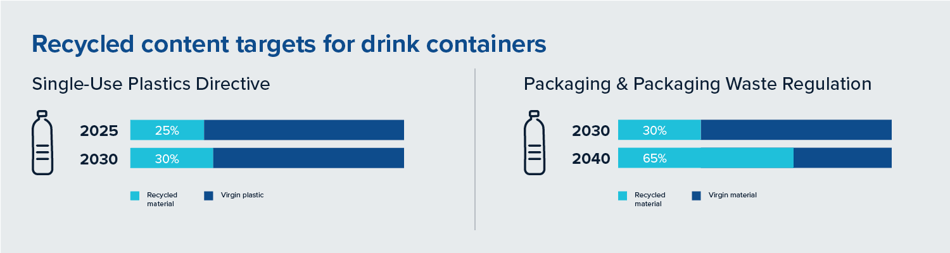
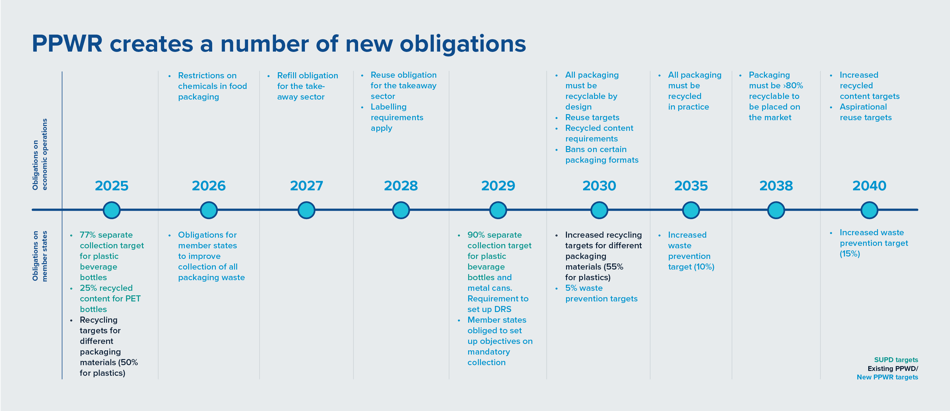
The EU’s Packaging & Packaging Waste Regulation (PPWR), voted into law in December 2024, extends the SUPD’s efforts and aims to harmonize recycling across Europe. The PPWR goes a step further, requiring each EU member state to implement a deposit system for cans and plastic bottles by 2029, to achieve the goals for separate collection and recycled content. The PPWR states DRSs should span drinks in plastic or metal containers up to three liters in size, but can exempt containers under 0.1 liters. Member states should also endeavor to include glass and cartons where appropriate. The PPWR also sets minimum requirements for DRSs, such as a sufficient deposit value, clearly labelled containers, and reinvestment of unredeemed refunds into public education on the deposit system.
Results of deposit return schemes across Europe
“The implementation of DRS has yielded significant environmental and social education results across Europe,” shares Thomas Morgenstern.
DRSs have led to exceptionally high collection rates and recycling rates. Germany today boasts drinks container return rates exceeding 98%, and Norway achieves 92%. Lithuania jumped from a return rate below 34% before its deposit system, to an impressive 92% just two years later. Slovakia reached a return rate over 70% in its first year, exceeding its goal of 60%. “Most recently, within seven months of Ireland’s DRS launch in February 2024, the country achieved a 73% return rate, putting it well on track to reach the EU collection target of 77% by the end of 2025.”
DRSs also see substantial reductions in litter. In Norway, less than 1% of drink containers are littered, and only one in eight bottles washed up on the coastline are Norwegian; the rest come from neighboring countries. Two years into its deposit return scheme, Latvia recorded a 61% reduction in plastic containers in coastline litter, and a 49% reduction among all deposit refund scheme containers. 54% of consumers said the environment had become cleaner after the DRS. In Slovakia, drink cans made up 20.5% of collected litter 1.5 years before the DRS (with PET bottles making up 15%), dropping to 2.2% just 1.5 years after the return scheme (and 3.2% for PET bottles). Six months after Ireland’s deposit return scheme launch, it was announced the DRS had led to a huge reduction in drink containers found in coastal clean-ups.
Socially, DRSs raise public awareness and change behaviors around recycling and waste reduction. In many countries, a new DRS has been accompanied by educational campaigns, fostering a culture of recycling and environmental responsibility. By the end of Lithuania’s first year with DRS, 99.8% of the public were aware of the system, with 89% having used it at least once; 58% reported recycling more, and 78% believed the deposit scheme was good and necessary. In Norway, more than 92% said it is very important for them to be able to return every container; they believe it is good for the environment, and trust the system. Research 1.5 years into Latvia’s DRS found the system is used at least once per month by 80% of the population, and by 94% of households.
What’s next for deposit return schemes in Europe and the EU
“The future of DRS in Europe looks busy and bustling, with several countries planning to implement these schemes in the coming years,” explains Thomas Morgenstern.
Austria introduced its DRS on 1 January 2025, aiming to increase the recycling rate from the current 70% to 90% by 2027, to reduce litter and enhance high quantity and quality resource recovery. Poland introduced its DRS in October 2025. Portugal has announced it will begin with a deposit scheme in 2026. In January, DRS regulations for England and Northern Ireland in the United Kingdom were passed by both hours of parliament, with the deposit refund scheme set to go live in October 2027. Greece and Spain are also aiming for DRS implementation.
As we look to the future, continued modernization and innovation will be essential as DRS becomes a cornerstone of Europe’s circular economy.

“Deposit systems have proven to be an effective tool in European countries' efforts to enhance their collection rate and recycling rate, reduce waste, combat litter, and reuse valuable resources. The history, current trends and future prospects of DRS highlight their importance in achieving recycling and waste management goals. As we look to the future, continued modernization and innovation will be essential as DRS becomes a cornerstone of Europe’s circular economy.”

Learn more about deposit return schemes in Europe

Recycling role model Norway achieves 92% return rate

World’s highest-performing DRS, Germany, reaches 98% returns
