DEPOSIT RETURN SCHEMES: SYSTEM SPOTLIGHT
A modern deposit return system: Quebec, Canada
Quebec’s deposit return system (DRS) modernization has been getting international attention for its thoughtful approach to balancing stakeholder needs and aiming for a 90% return rate.
Quebec deposit return scheme snapshot:
- Population: 9.01mi.
- Deposit value: 10₵ for all deposit containers besides glass containers larger than 500ml, which have a 25₵ deposit value.
- Eligible containers: As of February 2025 - All beverages besides ready-to-drink beverages and medicinal beverages in metal containers, beer in glass bottles, soft drinks in plastic bottles. March 2025 - Addition of all beverages in plastic bottles. 2027 - Addition of wine and liquor in glass bottles and all beverages in cartons (liquid paperboard). Excluded - Containers less than 100ml and greater than 2 liters, as well as pouches.
- Redemption network: Hybrid (return to retail and redemption center).
Home to over one million lakes and rivers, the Canadian province of Quebec has a proud history of protecting its natural resources. A brewery in Quebec has offered a refillable beer program since 1927. In 1984, to reduce litter and divert waste from landfills, policymakers adopted a deposit return system (DRS) for one-way glass and metal beer and soda containers. These Extended Producer Responsibility (EPR) collection programs work by providing a financial incentive for consumers to return and recycle rather waste or litter beverage containers.
Over time, the scope and performance of this collection program required an update. Reforms adopted in 2022 have gained international attention due to their focus on convenience for the public, cost efficiency for the beverage industry, flexibility for retailers, and high ambitions for environmental impact.
Over time, the scope and performance of this collection program required an update. Reforms adopted in 2022 have gained international attention due to their focus on convenience for the public, cost efficiency for the beverage industry, flexibility for retailers, and high ambitions for environmental impact.
The first generation of Quebec’s deposit return: 1984-2022
Quebec’s initial deposit system charged consumers a deposit between 5 and 20 cents (depending on the beverage type and container size), which was refunded in full when they returned it to a beverage retailer. Redemption centers (or “depots”) were not offered as alternative return locations. This first iteration of the program only included carbonated soft drinks and beer. Each beverage category formed their own Producer Responsibility Organizations (PRO) to manage the DRS responsibilities of their beverage company members, one PRO for beer and one PRO for soda.
The catalyst for change in Quebec’s deposit return system
Over time, the return rate of deposit containers stagnated around 72%. Given high-performing deposit systems reliably achieve return rates of 90% and higher, stakeholders saw a need for intervention. At the same time, beverage categories that hadn’t existed in 1984, like bottled water, had become popular yet were not eligible for a recycling refund. The curbside recycling system, managed by its own PRO, by contrast achieved a 52% recycling rate for common recyclables.iiIn addition, Quebec is home to a local circular economy complete with glass, PET and Tetra Pak container manufacturers and processors. With relatively low return rates in the deposit system, many of these manufacturers were forced to import material from outside the province, at higher cost and greenhouse gas emissions. Modernizing the DRS presented an opportunity to support local manufacturing, reduce litter, increase recycling, reduce GHG emissions from producing packaging and increase jobs. When the government polled the public, eight out of 10 households agreed that a deposit system with all beverages and a meaningful deposit value would increase recycling, make redemption simpler and motivate them to return their containers.iii
Key features of Quebec’s deposit return system modernization
To revitalize its DRS, Quebec reviewed the best practices of deposit programs that reach 90%+ return rates, namely: circularity, performance targets, convenient and accessible refunds, system management, and system integrity.iv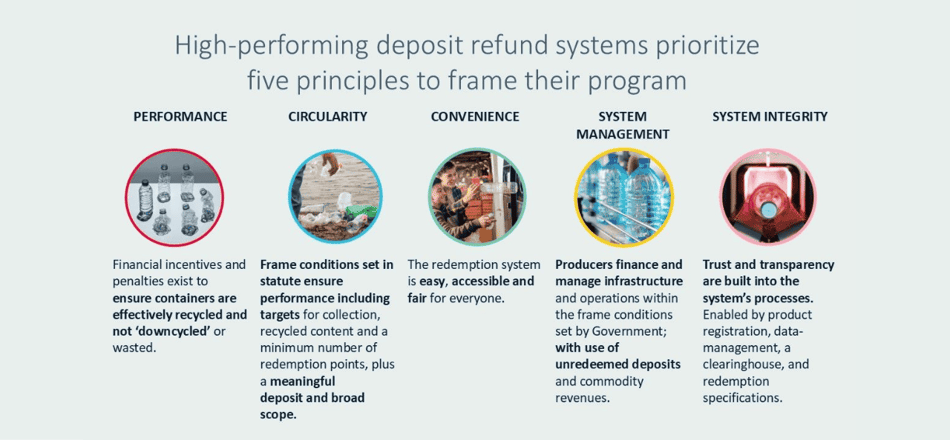
In practical terms this meant Quebec:
- Set performance targets including a 90% return rate: An ambitious return rate target is critical for high-performing DRSs, because it clarifies the objective of the system among all parties and aligns investment decisions amongst the beverage and retail industries. A meaningful deposit value on its own can enable average return rates, but reaching 90% is only possible with a thoughtful and convenient return infrastructure. Quebec set both collection and recycling targets by material type. The regulations state if the targets are missed by more than 10% for two consecutive years, the deposit value can be increased.v
- Made more material types eligible for a deposit refund: Previously only one-way cans and glass bottles and refillable glass bottles were included in the system. The reforms added plastic bottles (March 2025) and Tetra Pak paper cartons (2027). Containers less than 100ml and greater than 2 liters and pouches are excluded.
- Made more beverages eligible for a deposit refund: The reforms stated that eligibility in the system would be determined by the recyclability of the container material, not the liquid inside. Previously only soda, beer and flavored water were eligible for a refund. In November 2023, all beverages in metal cans were added to the system, all beverages in plastic bottles will be added in March 2025, and in 2027 wine, liquor and beverages in Tetra Pak paper cartons will be added. Ineligible beverages include concentrates, ready-to-drink beverages, condiments, and medicines.
- Raised and standardized the deposit value to 10₵: Previously all cans were only eligible for a 5₵ deposit, smaller one-way glass bottles were at 10₵ and larger glass bottles were at 20₵. The reforms made all eligible containers 10₵ with the exception of glass bottles larger than 500ml, which were set at 25₵. The meaningful deposit value was designed to engage consumers to reach higher recycling rates.
- Streamlined the DRS management from two PROs into one: To simplify the transition, policymakers required the two entities managing the DRS to form one new PRO. The centralized model for managing EPR programs through a PRO is more common in Canada where most provinces have existing EPR for packaging programs and DRSs. In Quebec, the new PRO, the Quebec Beverage Container Recycling Association (QBCRA/AQRCB) has been designated by the regulatory body, Recyc-Quebec, to carry out implementation of the reforms such as investing in new return locations, negotiating contracts with retailers, and communicating with the public.
- Adopted a hybrid redemption system and guaranteed redemption access through a convenience standard: To balance the consumer’s right to easily get back their deposit money and the needs of retailers, policymakers set a minimum number of return locations be provided by the beverage industry. Policymakers determined at least 1,200 return locations were needed in the new system, and stipulated regions should have access to a certain number of return locations depending on population. The regulations place responsibility for this on the beverage industry-run PRO. Retailers 375 square meters and up are required to take back containers. The PRO is required to negotiate sorting, pickup and compensation with participating retailers. If the parties cannot agree on terms, they are escalated to a formal mediation process. Retailers sharing a parking lot may collectively finance a return center on their lot. To be eligible to open a return center, participating retailers must be located within a certain distance of one another depending on the area’s population. In addition, to serve high-volume redeemers, the beverage PRO is authorized to open high-volume depots.
- Modernized the EPR for Packaging system at the same time: Quebec has operated an EPR for Packaging program since 2006. The system was achieving subpar performance, with a 52% household recycling rate and minimal recycling of glass.vi Policymakers undertook modernization of both the DRS and the EPR for Packaging program at the same time, including setting binding performance targets for both collection systems.

Quebec’s deposit return system modernization has already started to make an impact
Expansion of deposits to more beverage categories and material types is expected to add over two billion more containers sold to the system – from about 2.1 billion to 4.9 billion once all expansion stages are complete. All beverages in metal cans were added to the system in November 2023 and all beverages in plastic bottles are set to be added in March 2025.
AQRCB has begun building modern depots across the province. As of January 2025, 30 depots have been built and hundreds more are planned.vii In addition, AQRCB, in partnership with retailers, has begun building “kiosks” at certain retailers, which offer automated return technology. The depots, branded as “Consignaction+”, are equipped with the latest technology in DRS redemption including bulk-feed or “bag dump” RVMs that can process over 100 containers per minute and refund deposits as paper vouchers or via a digital phone application. The depots also offer bag-drop services that allow redeemers to return containers in bulk and get refunded later through a phone application. Further, the depots offer single-feed RVMs that act like an express check-out counter for those who just want to redeem a low volume of containers and avoid any lines for the bulk equipment.
AQRCB has begun building modern depots across the province. As of January 2025, 30 depots have been built and hundreds more are planned.vii In addition, AQRCB, in partnership with retailers, has begun building “kiosks” at certain retailers, which offer automated return technology. The depots, branded as “Consignaction+”, are equipped with the latest technology in DRS redemption including bulk-feed or “bag dump” RVMs that can process over 100 containers per minute and refund deposits as paper vouchers or via a digital phone application. The depots also offer bag-drop services that allow redeemers to return containers in bulk and get refunded later through a phone application. Further, the depots offer single-feed RVMs that act like an express check-out counter for those who just want to redeem a low volume of containers and avoid any lines for the bulk equipment.

Modern depots designed to handle high-volume redeemers are being built across Quebec.
By reaching the 90% return rate, a government study projected that each year the DRS would divert 50,500 tons from landfill and avoid the GHG emissions equivalent to removing more than 5,600 cars from the road for one year. The same study found that modernizing the DRS and the curbside collection system would create around 500 new jobs.viii

Have a question? Download the Frequently Asked Questions sheet on Quebec's deposit return scheme.
For more information on Quebec’s DRS modernization, including details on its performance targets, collection from bars and restaurants, and other topics, see this Frequently Asked Questions sheet.
For further information, fill in the form or reach out to:
[email protected]

More deposit return scheme best practice

Connecticut's deposit return scheme

Quebec's DRS Producer Responsibility Organization

White paper: Unlocking Circularity: Insights from high-performing deposit return systems
Footnotes
i“Quebec population surpasses 9 million,” CTVNews.CA. 2024.iiAlexis Eisenberg. Reloop. 2022. Via “Pathways to Circularity: The Link Between EPR & DRS Webinar,” TOMRA.com. December 2022.
iii"Perception des québécois à l’égard de la modernisation et de l’élargissement de la consigne,” Recyc-Quebec. 2021.
iv“Unlocking Circularity: Insights from high-performing deposit return systems,” TOMRA. 2025.
v“Q-2, r. 16.1 - Regulation respecting the development, implementation and financial support of a deposit-refund system for certain containers,” LegisQuebec.gouv.ca. 2022.
viAlexis Eisenberg. Reloop. 2022. Via “Pathways to Circularity: The Link Between EPR & DRS Webinar,” TOMRA.com. December 2022.
vii“QBCRA ends 2024 with major agreement with machinex deposit,” Newsire.ca. Dec 2024.
viii“Regulatory impact analysis of the regulatory projects concerning the modernization of deposit and selective collection systems,” Quebec Ministry of the Environment. 2022. Greenhouse gas equivalencies based on “Greenhouse gas equivalencies calculator” from the U.S. Environmental Protection Agency.