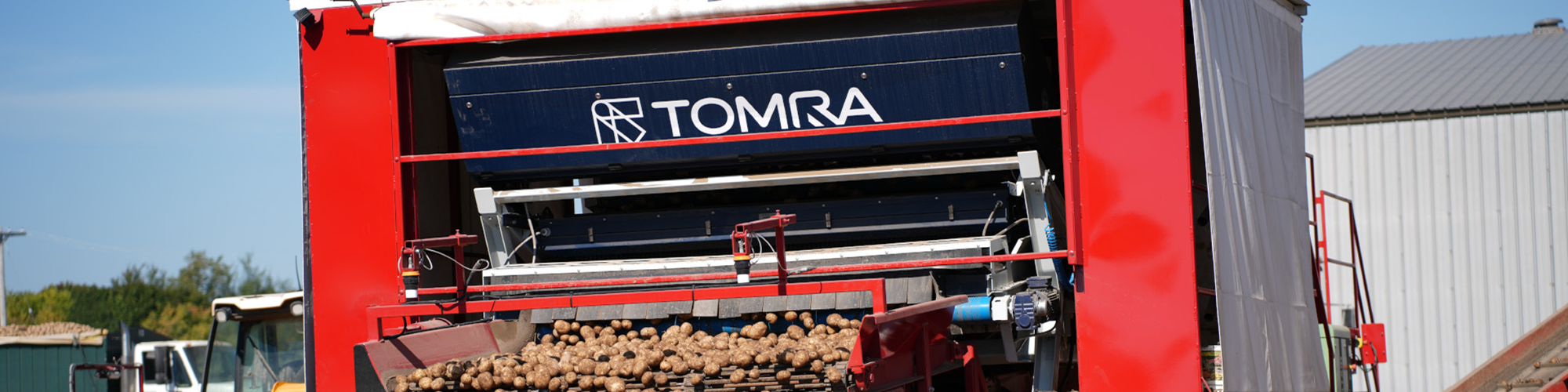
Technology
Air
How do we separate potatoes (or carrots or onions) from foreign materials to see every defect? We do it ‘in-flight.' Air Handling gives TOMRA sensors the ability to complete a very thorough and precise inspection of every potato, onion, or carrot while also detecting foreign material and unsafe produce.
Why air handling is perfect for whole vegetables
Why does a lumpy, uneven vegetable suit air inspection so well?
It’s the potato’s mass, shape, and motion.
Potatoes and other similarly shaped and weighted products maybe be asymmetrical, but the mass compared to their size allows inertia so they can travel.
Because of the potato’s uneven shape, the air resistance around the product fluctuates, which means it doesn’t fall straight, like a tomato or a berry. Similarly, it’s heavy mass compared to its size means inertia sends it flying further than other vegetables.
What’s more, air handling allows for very high capacity sorting and enables the removal of large foreign material
The result: a potato gives the time and perspective for a thorough and precise inspection without creating interference with the sensors.

Why choose Air handling
Working principles for the Air portfolio
TOMRA 3A
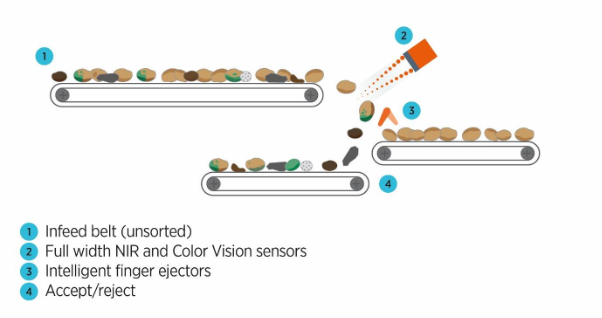
Potatoes are loaded onto the entire width of the conveyor and progress towards the inspection area. Air inspection ensures every single potato is inspected. While in the air, the potatoes are scanned by Pulsed LED sensors and cameras. A few milliseconds later, high speed ejection fingers remove the foreign material and defective products to the reject conveyor. The good products continue to a soft landing on the next conveyor.
TOMRA 5A
The produce is spread uniformly onto the infeed belt and is scanned in air by cameras on both sides. A few milliseconds later, the defects are rejected by intelligent finger ejectors, positioned on the end of the infeed belt, while the good produce continues its way along the sorting line.
The following visual explains:
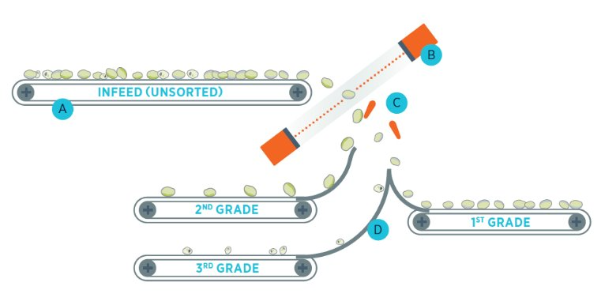
A) Infeed
B) Sensors
C) Intelligent ejection fingers
During the inspection the peel removal quality is also measured and analyzed by the optional peel control module. In case of significant differences between the measured quality and the customer-specific settings, the peeler settings are automatically adjusted
Explore the TOMRA Air portfolio
.jpg?hash=710850f6c133d40d8a5491713393fd1347ac3fb0fadde7a53581b9fe085a5bdc&w=710&h=398&q=75&fit=crop&format=webp)
TOMRA 3A
Applications: Field Potatoes, Fresh Pack Potatoes, Onions, Beets
.jpg?hash=aadbf590d6bd4ba4413f12a036aa06dfc44027c4a3fe30086851834b999169b6&w=710&h=398&q=75&fit=crop&format=webp)
TOMRA 5A
Applications: Fresh Pack Potatoes, Beets, Brussel Sprouts, Peppers, Gherkins, Radishes, Peaches
.jpg?hash=a9fca72b0f64cf1ae5e402b12cea730e54448b0cf1acaa2b75e30078091a5830&w=710&h=398&q=75&fit=crop&format=webp)
Sentinel II
Applications: Green Beans, Peaches, Potatoes, Tomatoes
Learn more about associated technologies

Artificial Intelligence

Camera